General Dietary Considerations for Adult Men
An educational overview of broad nutritional patterns, key nutrient groups, and common dietary considerations relevant to men's overall well-being — presented factually and without individual recommendations.

How Dietary Patterns Are Discussed in Nutritional Science
In nutritional literature, dietary patterns for adult men are often discussed in terms of macronutrient distribution, micronutrient sufficiency, and food group variety. These broad frameworks are used to describe general eating behaviors rather than to prescribe specific regimens.
Men's nutritional needs are generally described in relation to body composition, energy expenditure, and age. As with all adults, adequate intake across the major nutrient categories — proteins, carbohydrates, fats, vitamins, and minerals — is emphasized in public health guidelines as a foundation for general well-being.
- Variety across food groups supports comprehensive nutrient coverage
- Energy requirements generally relate to body size and activity level
- Consistent eating patterns support stable physiological function
- Whole and minimally processed foods are frequently highlighted in dietary guidelines
Nutrients Commonly Referenced in Men's Nutritional Context
The following nutrients are frequently discussed in the nutritional science literature as relevant to adult men's general dietary adequacy. Information is presented for educational awareness only.
Zinc
Zinc is a trace mineral involved in numerous enzymatic processes throughout the body. It is present in pumpkin seeds, legumes, whole grains, and lean meats. Adult men are among the groups for whom adequate zinc intake is frequently mentioned in nutritional guidelines.
Vitamin D
Vitamin D is a fat-soluble vitamin synthesized by the skin upon sunlight exposure and obtained from dietary sources including oily fish, egg yolks, and fortified foods. It is involved in a range of physiological functions described in nutritional literature.
Omega-3 Fatty Acids
Omega-3 fatty acids — including ALA, EPA, and DHA — are essential polyunsaturated fats found in oily fish (such as salmon and mackerel), walnuts, flaxseeds, and chia seeds. They are widely discussed in nutritional science as important components of a balanced diet.
Magnesium
Magnesium is a major mineral that participates in over 300 enzymatic reactions in the body. Dark leafy greens, nuts, seeds, legumes, and whole grains are widely cited as food sources of magnesium in nutritional reference materials.
B-Complex Vitamins
The B-complex vitamins — including B1, B2, B3, B5, B6, B7, B9, and B12 — are a group of water-soluble vitamins involved in energy metabolism and cellular function. Whole grains, legumes, leafy vegetables, eggs, and lean meats are common dietary sources.
Selenium
Selenium is a trace mineral with antioxidant properties described in nutritional literature. Brazil nuts are among the most concentrated food sources, alongside fish, eggs, and whole grains. It functions as a component of selenoproteins in the body.
Protein Intake: What Nutritional Guidelines Describe
Protein is consistently highlighted in nutritional science as a macronutrient of importance for adult men. It supplies essential amino acids that the body cannot synthesize independently. These amino acids serve as structural components for tissues, enzymes, and other functional molecules throughout the body.
Dietary guidelines for adult men generally discuss protein intake in relation to body weight, with recommendations often expressed per kilogram of body mass. Both animal-based and plant-based food sources are recognized as providing dietary protein, with varying amino acid compositions.
| Food Source | Protein Type | Notable Additional Nutrients |
|---|---|---|
| Eggs | Complete (animal) | Vitamin D, choline, B12 |
| Lean poultry | Complete (animal) | Niacin (B3), selenium, phosphorus |
| Oily fish | Complete (animal) | Omega-3, iodine, Vitamin D |
| Legumes | Incomplete (plant) | Dietary fiber, folate, iron |
| Tofu / Tempeh | Complete (plant) | Calcium, manganese, isoflavones |
| Whole grains | Incomplete (plant) | Fiber, B vitamins, magnesium |

Educational content only. No promises of outcomes. All information is for general awareness purposes only.
The Role of Dietary Fats in Men's Nutrition
Dietary fats are an essential macronutrient group for all adults. In men's nutritional discussions, healthy fats — particularly unsaturated varieties — are frequently cited for their role in supporting cellular structure, fat-soluble vitamin absorption, and general metabolic function.
Omega-3 fatty acids, found in oily fish, walnuts, and flaxseeds, are among the most studied lipids in nutritional science. Monounsaturated fats, present in olive oil and avocados, are also consistently highlighted in dietary frameworks for adults.
Informational note: Individual fat intake recommendations vary based on overall caloric needs and health status. This information is presented as a general educational overview and does not constitute dietary guidance for any individual.
Monounsaturated Fats
Found in olive oil, avocados, and almonds. These are liquid at room temperature and are commonly featured in Mediterranean-style dietary patterns described in nutritional literature.
Polyunsaturated Fats
Include both omega-3 and omega-6 fatty acids. Sources include oily fish, walnuts, sunflower seeds, and flaxseeds. Both types are considered essential as the body cannot produce them independently.
Saturated Fats
Present in dairy, red meat, and coconut oil. Public health frameworks generally recommend consuming these in moderation as part of a varied dietary pattern that prioritizes unsaturated fat sources.
Fat-Soluble Vitamins
Vitamins A, D, E, and K require dietary fat for absorption. This is one reason why nutritional guidance emphasizes including healthy fat sources as part of a balanced overall diet.
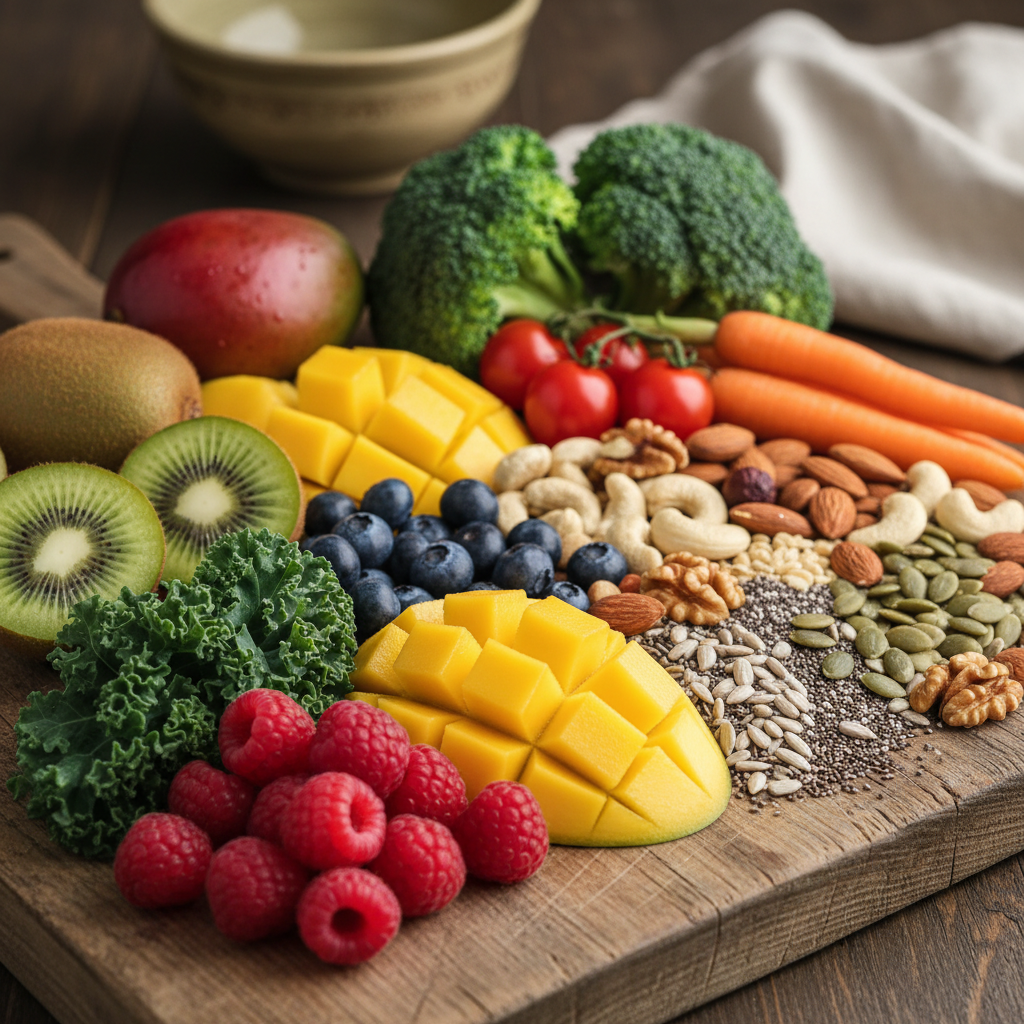
Antioxidant-Rich Foods in Men's Dietary Discussions
Antioxidants are compounds found in a wide variety of plant-based foods that help neutralize reactive oxygen species — unstable molecules that are a natural byproduct of cellular metabolism. Nutritional science frequently discusses the role of dietary antioxidants as part of a balanced eating pattern.
Foods rich in antioxidants include berries, dark leafy greens, green tea, dark chocolate, and a range of colorful vegetables. These foods also typically provide vitamins C and E, beta-carotene, selenium, and polyphenols — all of which are referenced in nutritional guidelines for adults.
- Berries: blueberries, raspberries, and strawberries contain polyphenols
- Dark leafy greens: spinach and kale provide vitamins C, E, and K
- Nuts and seeds: sources of vitamin E and selenium
- Tomatoes: contain lycopene, a carotenoid antioxidant
- Green tea: a plant-based source of catechins and other polyphenols
Common Dietary Patterns Discussed in Men's Nutritional Context
Nutritional science describes several broad dietary patterns that are frequently referenced in relation to adult health. These are presented here as informational concepts, not as personal recommendations.
Mediterranean-Style Pattern
Characterized by a high intake of vegetables, legumes, whole grains, olive oil, and moderate consumption of fish and dairy. Extensively studied in nutritional science and widely referenced in adult dietary guidelines across Europe.
Plant-Forward Pattern
Emphasizes plant-based foods — vegetables, fruits, legumes, whole grains, nuts, and seeds — as the primary dietary foundation. Often associated in nutritional literature with broad micronutrient sufficiency and adequate dietary fiber intake.
Balanced Omnivore Pattern
Incorporates a wide variety of animal and plant foods with emphasis on portion balance across all food groups. This is the framework most commonly described in general public health dietary guidelines, including those published in Switzerland.
Key Vitamins and Minerals: Educational Overview
| Nutrient | Type | Primary Dietary Sources | Role in the Body (General) |
|---|---|---|---|
| Zinc | Trace Mineral | Pumpkin seeds, legumes, whole grains, lean meats | Enzyme co-factor, immune function support |
| Vitamin D | Fat-Soluble Vitamin | Oily fish, egg yolks, fortified foods, sunlight exposure | Calcium regulation, cellular processes |
| Magnesium | Major Mineral | Dark leafy greens, nuts, seeds, whole grains | Involved in 300+ enzymatic reactions |
| Omega-3 (EPA/DHA) | Essential Fatty Acid | Salmon, mackerel, sardines, herring | Structural component of cell membranes |
| Vitamin B12 | Water-Soluble Vitamin | Meat, fish, dairy, fortified plant foods | Nerve function, red blood cell formation |
| Selenium | Trace Mineral | Brazil nuts, fish, eggs, whole grains | Antioxidant enzyme activity |
| Vitamin C | Water-Soluble Vitamin | Bell peppers, citrus fruits, broccoli, strawberries | Collagen synthesis, antioxidant activity |
| Potassium | Major Mineral | Bananas, potatoes, avocados, beans | Fluid balance, nerve signal transmission |
Information and Context
All content on this page is presented for general educational purposes only. It describes broad nutritional concepts as discussed in public health and nutritional science literature. Nothing on this page constitutes personalized dietary advice, individual recommendations, or guidance for managing any specific health condition. Nutritional needs vary considerably between individuals based on factors including age, activity level, health status, and other circumstances. For questions related to personal nutrition or health, consulting a qualified professional is always advisable.
Explore More Nutritional Concepts
Browse the full knowledge base to learn more about dietary principles, essential vitamins, and the role of food in adult well-being.